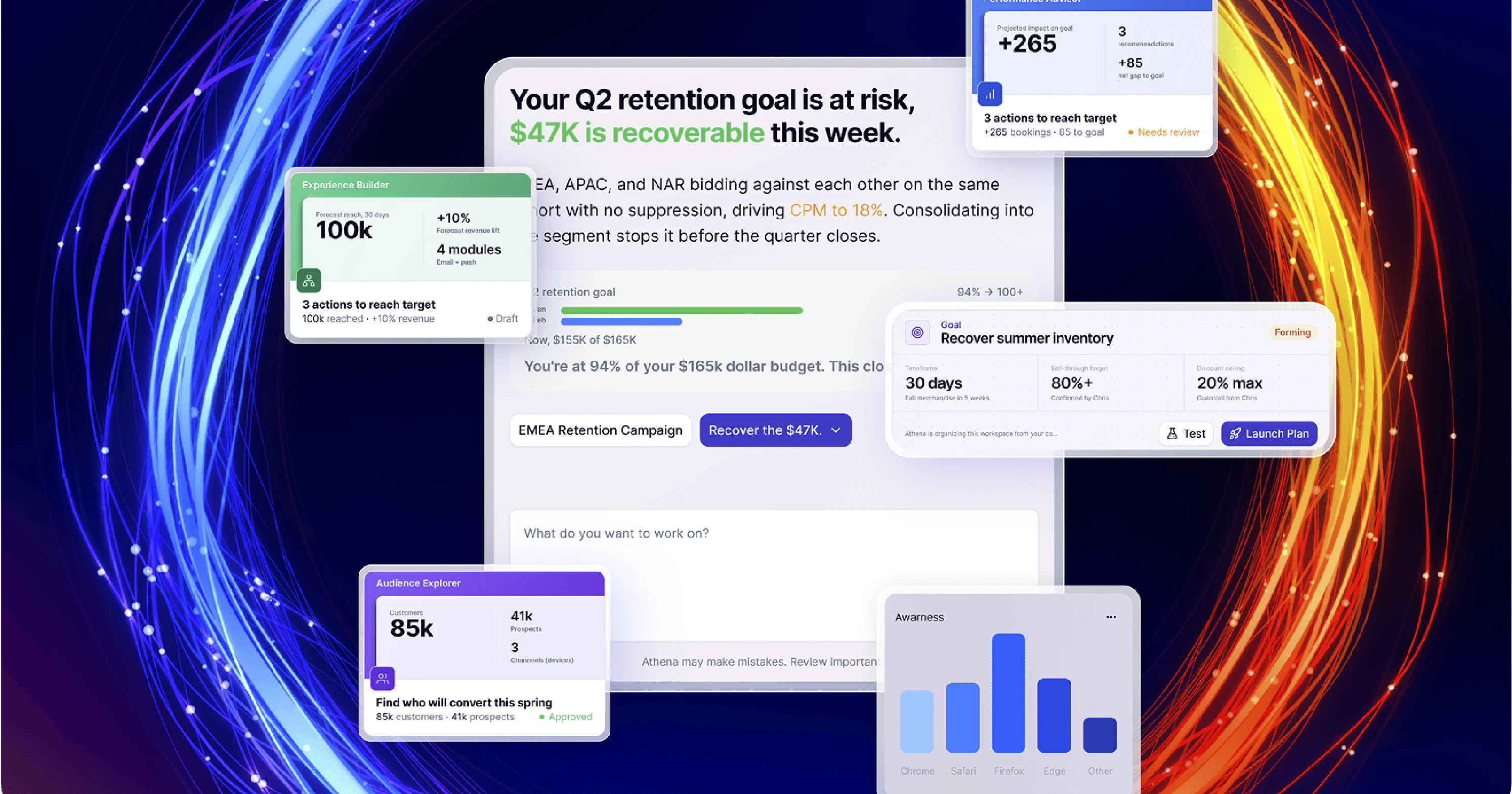
Zeta Unveils AthenaOS: The Operating System for Enterprise Intelligence
Zeta unveils AthenaOS: Explore planned capabilities, from dynamic workspaces to AI assistant integrations and smarter media decisions.

Zeta Global Teams Up with Fireworks to Unveil New Specialized Athena Inference Models Using NVIDIA NemotronRead News
Inside Zeta’s work with Fireworks to make AI more useful for specific marketing tasks
At Zeta, we’re developing specialized AI models with Fireworks—called Athena Inference Model (AIM)—for specific tasks within AthenaOS, our Enterprise Intelligence Operating System. AIM is being built in partnership with Fireworks using NVIDIA Nemotron open models to help interpret marketing language and follow requirements such as brand voice and output format.
Access to capable models is becoming more widespread. Competitors can use the same underlying technology, but they bring different customer relationships, operating constraints, and knowledge of what works. A company’s data and understanding of their customers is their competitive moat.
AthenaOS is at the center of Zeta’s intelligent AI infrastructure, designed to connect that enterprise context with Zeta’s customer and market intelligence, applications, and actions around a business objective. Specialized models help particular tasks within that system perform more reliably and efficiently.
The engineering question is which model and training approach best serve each task. That choice has to account for the complexity of the work, the cost of running it repeatedly, and evidence that an adaptation improves performance.
Consider a team trying to reconnect with loyalty members whose engagement has declined. Understanding the problem requires customer history, recent behavior, previous campaign results, and the business’s priorities. A recommendation may also depend on which offers are available and what the business can afford.
That information provides context. It helps distinguish a recommendation that sounds reasonable from one that fits the customer and the business.
Carrying out the work also places demands on the model itself. It may need to interpret terminology used in a loyalty program, write within brand guidelines, or return information in a structure that another application can process. If a required field is missing or an output takes the wrong form, someone may have to correct it before the work can continue.
Those are examples of the kinds of requirements specialization can address. Connecting a model to current customer data and teaching it to follow a required output structure to solve different problems—a useful system needs to account for both.
A model’s initial training gives it general capabilities. Post-training is the process of adapting its behavior after that initial training, using examples and feedback to improve how it performs particular tasks.
The starting point is the specific failure we need to address. If a model lacks current business information, further training may not solve the problem; it needs access to that context. If it repeatedly struggles to follow a defined requirement, supervised fine-tuning can help by training it on curated examples of the desired responses. We should use the least intensive approach that closes the measured gap.
Another technique is distillation, in which a more capable model helps train another, often smaller model for certain tasks. A team might use it to retain the capability needed for recurring work while aiming to reduce response time or operating cost. Those benefits still need testing. Distillation is one option in the broader post-training toolkit; the right technique depends on the task.
Open-weight models make their weights (the numerical settings learned during training that shape responses) available under the model’s license. Teams with the necessary expertise and infrastructure can further train and run the model. Access to the weights gives developers more control over that process.
Our collaboration brings together Zeta’s proprietary intelligence and marketing expertise with Fireworks’ infrastructure for training, tuning, and serving open models. AIM uses NVIDIA Nemotron as its foundation and is being fine-tuned for specialized AthenaOS tasks.
AIM is intended to work alongside Zeta’s existing predictive models. More broadly, I think of model selection as a portfolio decision: different capabilities should handle the work they are best suited to.
A broad general-purpose model can help investigate an unfamiliar question or reason through competing explanations. A specialized model can handle a defined, recurring task where consistent behavior and response time are priorities. In the loyalty example, exploring an unexpected decline and producing outputs to a known specification place different demands on a model.
Open versus closed is a separate choice from general-purpose versus specialized. An enterprise can combine both approaches. The decision should follow the workload and its requirements, rather than a commitment to one model family for every job.
Specialization contributes to competitive advantage when it helps a business apply its own knowledge more effectively. The model remains one component of the system required to do that.
In the loyalty example, generating a message is one task. Deciding which customers to reach, which offer makes sense, and what to change after the campaign requires a connected understanding of the customer and the business.
That is the purpose of a System of Intelligence. It connects enterprise context with decisions and action, then uses outcomes to inform what happens next. AthenaOS is designed around that loop, with people setting objectives, applying judgment, and directing the work.
Learning within the system can mean using campaign results to improve the next recommendation. Updating a specialized model is a separate engineering decision that requires its own training and evaluation. Both can contribute to better performance, and each needs evidence that it is helping.
Our work with Fireworks applies that discipline to the models supporting AthenaOS. We’re focused on the tasks those models need to perform, the context that makes their work relevant, and the testing required to trust them in practice.
Explore how AthenaOS connects enterprise intelligence to action.
Athena Inference Model (AIM) is currently in development. AthenaOS is not yet generally available. Timing and features are subject to change.
Zeta unveils AthenaOS: Explore planned capabilities, from dynamic workspaces to AI assistant integrations and smarter media decisions.

Learn how a System of Intelligence combines customer data, AI, identity, and real-time context to help brands make better customer decisions.

Discover why AI is making answers abundant and how a System of Intelligence turns enterprise context into better decisions, actions, and learning.
Zeta's unified, intelligent system transforms deeper customer understanding into confident action, faster execution, and measurable business outcomes.