
Zeta Global Teams Up with Fireworks to Unveil New Specialized Athena Inference Models Using NVIDIA NemotronRead News
Zeta Global Teams Up with Fireworks to Unveil New Specialized Athena Inference Models Using NVIDIA NemotronRead News
Are we being punked? After years of warnings and preparation, Google has decided not to get rid of third-party cookies after all.
But that doesn’t mean we’re going back to digital marketing circa 2020 either.
Cookieless advertising and cookieless marketing are still significant opportunities for both advertisers and publishers. What do these opportunities look like? Technology continues to evolve and advance, but we have some answers for the here and now.

And Zeta is prepared to help marketers drive even better results—with or without cookies.
First things first—cookie deprecation was never about all cookies. It was only third-party cookies in the hot seat.
A cookie is a snippet of data from a website or technology vendor that is stored within a web browser and contains a user ID. These IDs are attached to individuals’ devices as they use the internet, which allows marketing/advertising platforms and content servers to serve personalized content and ads to each website visitor.
Cookies also serve as instrumental linkages in identity graphs that power people-based marketing strategies.
But there are two distinct types of cookies:
Due to privacy concerns, shifting consumer preferences, and increasing industry regulations, browsers were sunsetting third-party cookies (and some still are). But first-party cookies have consistently been alive and well throughout the ups and downs of cookie deprecation.
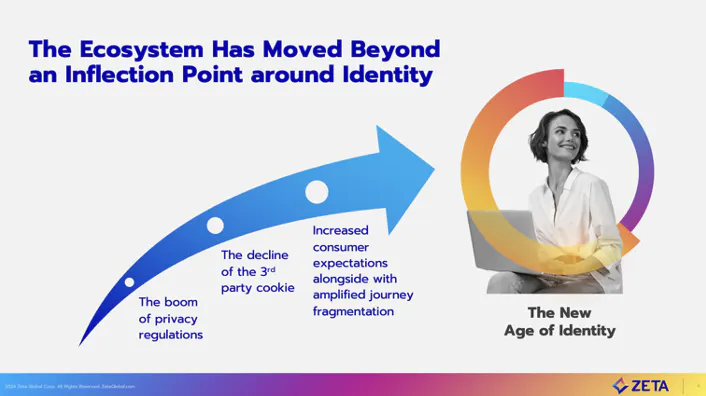
Google’s latest announcement doesn’t mean much in the long term. You can continue using your existing strategies for tracking and targeting users—but the broader trend towards privacy-first digital marketing isn’t going away.
Browsers like Firefox and Safari have already disabled third-party cookies, and consumer choices on Chrome will gradually reduce cookie reliance. If Chrome’s opt-in experience is anything like Apple’s App Tracking Transparency (ATT) functionality, you can expect only a small fraction of users to opt in (as of mid-2024, the ATT opt-in rate had sunk to only about 14% of users).
Third-party cookies currently fuel the majority of programmatic and digital advertising—and the decreasing reliability of these cookies will impact most of the tactics you rely on for effective campaigns.
As users opt out of Chrome’s tracking, advertisers will struggle with:
Even with third-party cookies still in play, it will be increasingly valuable to collect data directly from customers, with consent. As cookies become less and less reliable, maintaining addressability will be essential.
Embracing a cookieless advertising approach will help you to maintain a high level of addressability—while also guarding against future cookie changes. After all, Google could change its mind again any time!
The industry is developing and evaluating several new ways to provide cross-site data collection and persistent identifiers. This will be a time of adjustment for marketers as we all learn to work within this dynamic environment.
But there are a few key places to start adjusting.
You’ll hear this one everywhere—first-party data will continue to become more and more valuable. It will be critical to collect as much information about your own prospects and customers as possible, including:
It’s important, however, to make sure you’re collecting user consent (hello, cookie notice!) before implementing any first-party data strategy.
Data on its own won’t do much to restore your ability to target ads, reach consumers, or measure your marketing. This is where a strong, interoperable identity graph comes in. An identity graph allows you to onboard your first-party data, resolve it to a real person, and reach those people in other places.
Perhaps the most beneficial aspect of a strong identity graph is identifying and reaching anonymous browsers (or unauthenticated web traffic). Sans reliable cookies, and without an ID graph, you’re marketing to these browsers with less data and less precision. The result is poorer marketing performance and less-detailed insights about your own active customers and prospects.
Capitalizing on authenticated site traffic is still the gold standard for targeting accuracy. However, as you might expect, this is typically a tiny portion of your overall traffic.
The best identity graphs allow you to identify and advertise to both authenticated and unauthenticated traffic—which solves the problem of cross-site tracking.
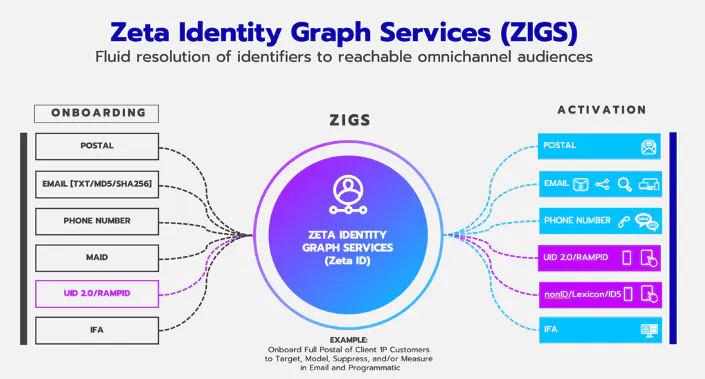
“This has historically been a cookie process—we cookie the browser and then we take that cookie ID, and we can go find you later because we can translate that to PII,” explains Jordan Seaton, Product Manager at Zeta. “In the cookieless version, we take a cookieless ID and do the same thing. So, the value of the graph is high because we’re able to just substitute cookieless identifiers for cookies.”
To solve the challenge of identifier persistency, martech and adtech platforms need to collect the most persistent browser-level identifiers possible. A native first-party cookie typically lasts for seven days. This is good enough for some attribution and may be sufficient for some use cases.
But the gold standard is the server-side cookie, which generally lasts a full year (365 days), even on iOS 17 (the strictest browser environment). Adopting server-side cookies, which are set and managed by the web server instead of the we domain, will greatly improve the quality of your customer profiles and give you the richest possible resolution on your users—across platforms.
Thankfully, some companies have been building cookieless marketing technology since the early days of deprecation—and Zeta is one of those companies. As third-party cookies become less reliable, Zeta is positioned to help you achieve your campaign goals.
For the past 12 years, we have invested in building a leading identity resolution solution that was purpose-built to handle any identity space—with or without third-party cookies.
Our identity graph consists of 235M+ US-based profiles, consolidated from more than 1.9B email addresses. This makes our ID graph one of the largest non-third-party cookie-based, deterministic data sets in the industry. This deterministic foundation allows you to reach audiences at scale and personalize 1:1 messaging at the record level.
Zeta’s identity graph is also compatible with leading cookie alternatives, allowing for a seamless transition between identity types.
To enhance addressability, Zeta is transitioning to the new Zeta Global Tag, built on a first-party foundation (including both server-side cookies and native first-party cookies). By shifting our tagging strategy to first-party cookies, we can increase signal quality and enable consistent user tracking.
We’re integrating with the best cookieless networks to accurately identify unauthenticated users and maximize campaign performance. These new partners will be rolling out throughout 2024 and will undergo continuous testing and optimization.
Regardless of cookie availability, investing in your authenticated traffic pipeline still represents the best use of resources. By passing this data through our java script tags or files, we can leverage our extensive dataset to transition these users into multiple identity types, giving you the best chance to reach your highest value prospects.
Zeta’s AI combines and interprets a wide range of proprietary signals on each person in our ID graph in near real-time. This allows you to build behavioral profiles to accurately predict actions, intent and brand propensity—without third-party cookies. Zeta’s AI automatically optimizes campaigns for performance against KPIs, including frequency capping, look-alike modeling and retargeting.
Thankfully, the pressure’s off when it comes to cookie deprecation. But that doesn’t change the fact that marketers and advertisers should still be working toward a cookieless future.
Google’s recent announcement shows that nothing is certain, and staying ahead requires more than just reacting to changes—it means anticipating them and being prepared with the right tools and strategies.
At Zeta, we’re committed to doing the work to create the most performant, full-featured solution in the market—regardless of identifiers. Our clients across industries are already delivering meaningful outcomes that don’t depend on third-party cookies (or Google’s fickle decisions).
Will you be next?
The Zeta Marketing Platform empowers businesses to offer highly tailored experiences driven by AI.