
Zeta Global Teams Up with Fireworks to Unveil New Specialized Athena Inference Models Using NVIDIA NemotronRead News
Zeta Global Teams Up with Fireworks to Unveil New Specialized Athena Inference Models Using NVIDIA NemotronRead News
The CDP industry has become increasingly fragmented over the past few years—which makes it increasingly difficult to understand which solution best meets your business’ needs.

Composable CDPs and Packaged CDPs are well established terms in marketing vocabulary, so most brands start off the decision-making process by asking:
But this is a false dichotomy that can derail your CDP decision from the get go.
Enter the Modular CDP—a hybrid architecture that combines the best elements of both packaged and composable solutions while eliminating their key drawbacks.
Rather than forcing you to choose between technical control and operational efficiency, modular CDPs offer a clear path forward for enterprises seeking sustainable growth in their customer data capabilities.
In this post, we’ll explore the components of a CDP, the key differences between Packaged, Composable, and Modular CDPs, and why the hybrid, modular approach is the best choice for most enterprise brands.
When you think of a CDP, you’re probably thinking of a more traditional, packaged CDP.
All of the necessary CDP functionality (ingestion, cleansing, enrichment, etc.) comes packaged as a ready-made solution optimized for specific use cases—including pre-defined features, tools, and integrations that make implementation fast and straightforward. This helps you get up and running quickly with minimal development effort.
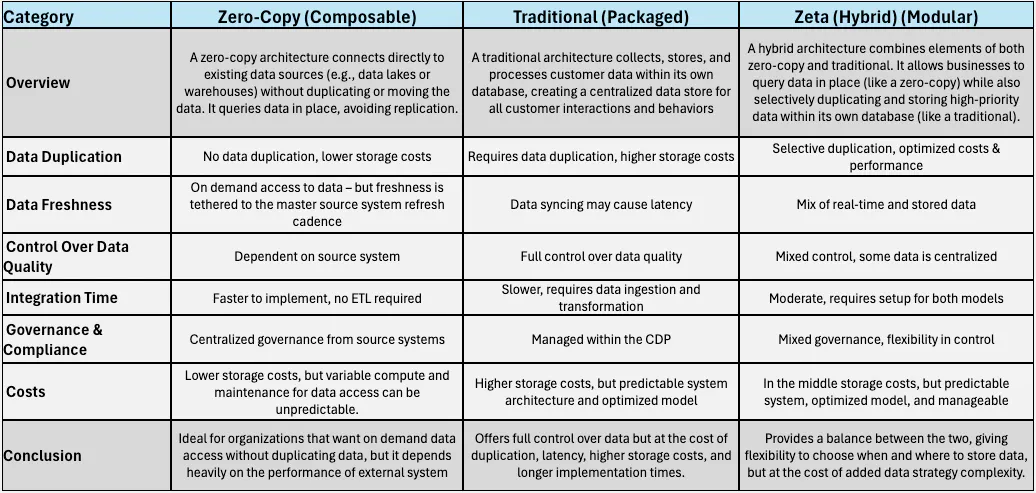
A traditional packaged CDP architecture collects, stores, and processes customer data within its own database, creating a centralized data store for all customer interactions and behaviors. While this approach allows for full control over data quality, it requires data duplication, which results in higher storage costs compared to a composable CDP.
The primary advantage of a packaged CDP is ease of use, including user-friendly interfaces and simplified data management. Drawbacks include:
Businesses that want more flexibility in their customer data management often consider a composable CDP.
A composable CDP is a set of disparate, unbundled software components that provide the various pieces of CDP functionality—integrated to meet the specific needs of the business. For example, your business may choose to implement one product for data cleansing and another product for data analytics and activation.
Creating a composable CDP requires a microservices architecture, which breaks down software applications into smaller, modular components that can be combined as needed. Also called a zero-copy architecture, these CDPs connect directly to existing data sources (e.g., data lakes or warehouses) without duplicating or moving the data. It queries data in place, avoiding replication and associated storage costs. Composable CDPs are usually managed by the company’s central IT teams as a universal repository intended to serve multiple purposes.
The primary upside to composable CDPs is the high degree of flexibility.
But that flexibility comes with some significant drawbacks to composable CDPs:
David Raab, Founder and CEO of The CDP Institute, explains that as composable CDPs have caught buyers’ interest over the past couple of years, traditional packaged CDPs quickly caught on to the demand—and began splitting their offerings into modules. In response, composable CDP vendors have started to offer multiple components and a complete set of CDP functions.
As packaged and composable CDPs grapple for market share, a new type of CDP has emerged: the modular CDP.
A modular CDP offers a hybrid approach that blends the best elements of both packaged and composable solutions. It gives marketers the freedom to customize the functionality in their CDP while still providing a user-friendly interface that streamlines data management and marketing operations.
This hybrid solution not only offers the flexibility needed to adapt to evolving business needs and strategies, but also ensures ease of use for marketers across various skill levels.
“While both the composable and packaged CDP options built on the data cloud offer clear advantages to marketers, combining benefits from both is an exciting proposition for modern marketers. Zeta Global and Snowflake together deliver the modern CDP built on a robust, secure and performant data foundation that empowers marketers to deliver differentiated customer experiences.”
Lourenco Mello
Product Marketing Lead, Snowflake
Zeta’s Modular CDP was designed based on the belief that creating better segments and driving better decisions requires the CDP to connect directly to the data warehouse AND manage real-time data (like behavioral data).
Our flexible approach allows you to choose the CDP modules and features that best suit your needs—from integration, hygiene and unification to enrichment, identity resolution and more.
The Zeta Marketing Platform empowers businesses to offer highly tailored experiences driven by AI.